Parking lot paving costs vary more than most property owners expect. This guide breaks down square-foot pricing, hidden extras, and what pushes Edmonton asphalt projects higher in 2026.
Request a Quote
Two parking lots with the same size can come back with very different quotes. The difference usually comes down to base condition, drainage, asphalt thickness, access, and whether the job is new paving, resurfacing, or full replacement.
For 2026 budgeting, most commercial asphalt jobs are best treated as planning ranges first. That gives owners a more realistic starting point before site-specific inspection and scope confirmation.
Use a planning range of about $5 to $10 per sq. ft. for straightforward commercial asphalt paving. Simple larger lots tend to price lower. Thicker sections, prep work, and tighter sites move higher.
When the base is still solid, resurfacing or overlay work often budgets lower than full replacement. It is usually the middle-cost option for lots that are worn but not structurally failing.
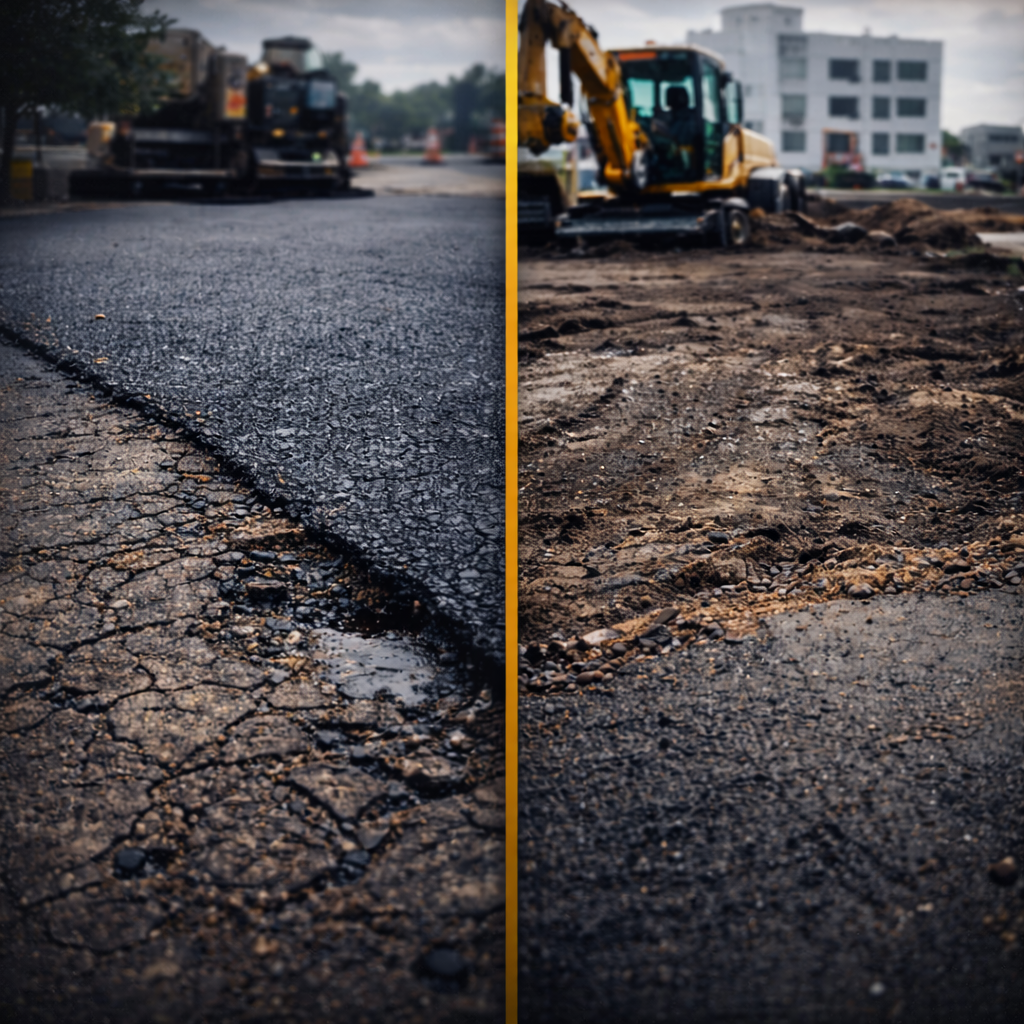
When the old lot must be milled out, removed, or rebuilt, costs rise fast. Demolition, disposal, and structural correction are often what create the biggest pricing gap.
The asphalt surface itself is only part of the number. The largest jumps usually come from what is happening below or around the pavement.
These numbers are planning examples, not fixed bids. Exact pricing still depends on inspection, layout, thickness, and site condition.
Not every lot needs to be torn out. If the base is stable, resurfacing can extend life at a lower cost. If the lot has widespread cracking, potholes, settlement, or water-driven failure, full replacement often delivers better long-term value.
The wrong choice wastes money. A cheaper overlay on a failed base usually does not stay cheap for long.
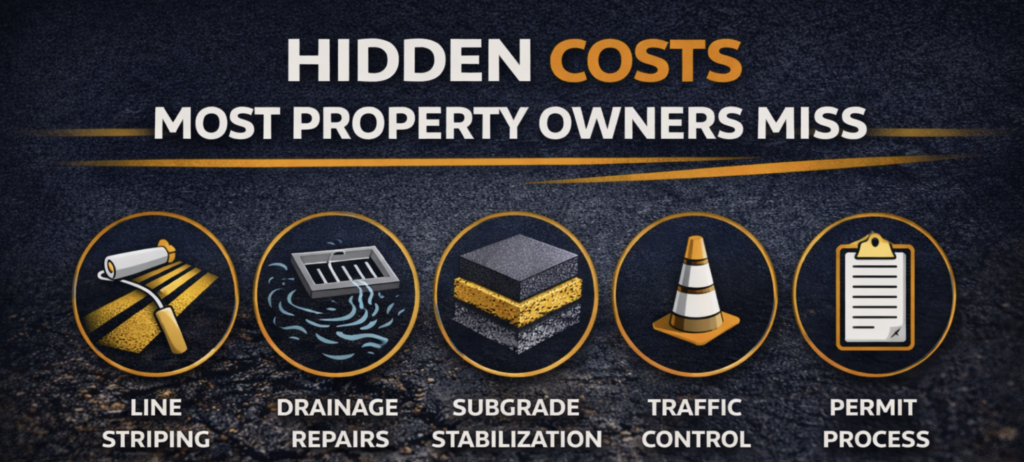
Early numbers often focus on asphalt only. The real project total usually grows when the site needs more than paving. Drainage corrections, subgrade stabilization, traffic control, line striping, curb repairs, and phased scheduling all add up. Edmonton parking-lot design rules can also affect total paved area through drive aisles, landscaped islands, and circulation layout.
That is why it is smart to compare scope, not only price. One contractor may include striping, catch basin resets, and grading. Another may leave them out and look cheaper on paper.
Spring is usually the best time to inspect, budget, and lock in paving work before peak summer demand tightens schedules.
Early planning also gives owners more time to compare repair, resurfacing, and replacement options before they commit.
Do not rely on a drive-by quote. The condition of the base, drainage, and existing asphalt matters more than rough square footage alone.
One bid may include grading, drainage, striping, and restoration. Another may not. A lower number is not always the better value.
A properly built lot with solid drainage and prep usually lasts longer and costs less over time than a cheaper job that fails early.
Parking lot paving costs in Edmonton are rarely as simple as a single dollar figure per square foot. In 2026, the smartest way to budget is to treat asphalt pricing as a planning range shaped by real site conditions. The most important variables are the condition of the base, drainage performance, thickness requirements, site access, and whether the project is new paving, resurfacing, or full replacement.
Many commercial paving projects start in the broad range of about five to ten dollars per square foot for straightforward asphalt work. Projects can land below or above that depending on complexity. The numbers rise when old pavement needs to be removed, when the base has failed, when drainage problems must be corrected, or when the site requires heavier-duty construction for truck traffic.
That is why two parking lots with similar size can come back with very different estimates. One may only need resurfacing over a stable structure. Another may need excavation, grading, catch basin work, and new asphalt installation from the base up. The difference is not the asphalt surface alone. It is everything under and around it.
Edmonton conditions make this even more important. Freeze-thaw stress is hard on pavement. Water infiltration is often the hidden cause behind potholes, settlement, and repeated patch failure. On top of that, city parking-lot design rules around circulation and landscaped islands can influence how much paved area a site really includes. These design details affect both quantity and construction effort.
Owners who want to avoid overpaying should focus on scope clarity first. Ask what is included. Ask whether the base has been reviewed. Ask whether striping, grading, and drainage are in the number. The cheapest quote often leaves out the items that matter most to long-term performance.
The better way to think about 2026 paving costs is simple. Use planning ranges for budgeting. Get a site-specific inspection before making decisions. Then compare proposals based on lifecycle value, not only the first number on the page.

Contact our Edmonton team for a site review, a clear paving scope, and pricing built around your property conditions.
Contact